Updated October 22, 2026
1. Has the amount of property taxes collected by the District gone up or down in the last several years?
During a referendum campaign, we often talk about the mill rate - the amount of property tax paid for every $1,000 of equalized value. It’s a helpful way to estimate how a referendum proposal could impact a homeowner.
The mill rate doesn’t show how much the school district actually collects in property taxes. That’s the levy: The total amount collected through local property taxes. This article answers the question about local property taxes.
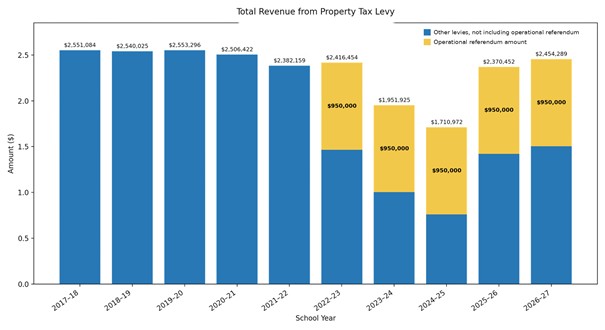
Over the past 10 years, Edgar School District’s property tax levy has decreased by about 4%, even including the current operational referendum. All levies allowed are shown by the blue bar. The existing operational referendum is represented by the yellow portion of the bar, which was approved to begin in the 2022-23 school year and expires on June 30, 2027.
2. Why does the levy change?
● The District paid off its Fund 39 debt service in 2024-25, thus the drop in levy.
● State revenue limits and General Aids: When limits rise without matching aid, local taxes make up some of the difference.
● Fluctuations and decisions made during the legislature’s state biennial budget process affect the revenue limit and General Aids.
This next graph shows projections of total levies, if the operational referendum is approved.
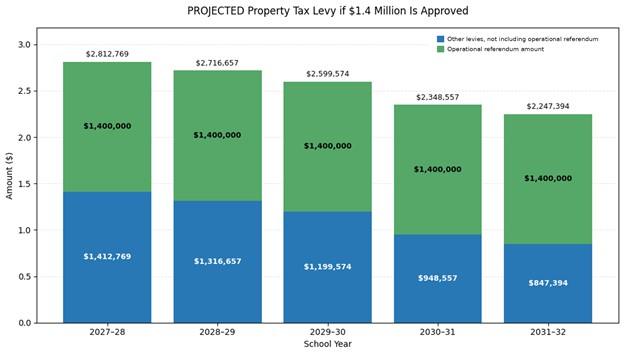
If approved, the projected total levy starts at about $2.81M in 2027-28. It then declines each year to about $2.25M by 2031-32. The $1.4M referendum portion stays flat for all five years. The decline comes from the “other levies” shrinking from about $1.41M to $847K. The mill rate likely will fluctuate during this time, depending on multiple factors.
3. Why is the Board seeking an increase in funds from an operational referendum (from $950,000 to $1.4 million)?
● Decreases in state funding, which have been flat for three years and haven’t kept pace with inflation in over 20 years, cause a structural deficit.
● Costs continue to rise for things such as transportation, utilities, maintenance, salaries, healthcare, etc.
● Unfunded and underfunded mandates: Examples include special education that is funded at about 40% but required for all qualifying children. The Act 20 reading mandate was unfunded in Edgar. Vouchers are costing over $380,000.00 this year.
4. What is the BALLOT QUESTION?
This is the question that will appear on the November 3 ballot:
Shall the School District of Edgar, Marathon County, Wisconsin be authorized to exceed the revenue limit specified in Section 121.91, Wisconsin Statutes, by $1,400,000 per year for five years, beginning with the 2027-2028 school year and ending with the 2031-2032 school year, for non-recurring purposes consisting of facility maintenance and operational expenses?
● Yes
● No
5. Why does the district need another referendum?
The current referendum expires June 30, 2027. State funding has remained flat, while inflation and the cost of maintaining current programs and staffing have increased. The state funding formula has not changed, causing an ongoing gap in revenue vs expenses. We don’t project being able to cut costs enough to fill the gap without significantly changing the level of education in Edgar School District.
6. Why can't the district live within the state-imposed revenue limit?
There are many reasons why school districts like Edgar must request additional funding from local property owners. In fact, 75% of districts in Wisconsin and 20 of 22 districts in our region operate using some sort of referendum funding. The reasons for this include, but are not limited to:
● Since the 2011-2012 school year, the state-imposed revenue limit has not kept pace with inflationary increases. While the Consumer Price Index (CPI) increased over 6% (July 1, 2024 vs July 1, 2026), there has been no increase in State funding since the 2024-25 school year.
● Unfunded mandates require schools to spend money in areas specified by the State and increase costs, but are not fully paid for by State or Federal sources. Examples include, but are not limited to:
○ Special education is funded at 40%, while the state requires districts to provide mandated services to all eligible children.
● An example of an underfunded mandate is ACT 20, which requires a specific reading program that must be instituted for all children; limited funds were provided, and none to Edgar School District.
● Private school vouchers cost Edgar School District $378,428 in 2026-27. This is the amount taken from Edgar’s State Aid and spent on students who do not attend Edgar School District; these students attend private schools such as St. John’s, Newman, Marshfield, and Columbus.
7. What has the district done to control costs?
● In response to enrollment, starting in 2025-26, in-house teachers are used for English Language Learners, offering the same support and greater efficiency.
● Reduced short-term borrowing and therefore decreased interest expenses.
● Rebalanced staffing in an effort to meet the needs of students and enrollment. Hired two elementary teachers and two part-time paraprofessionals in 2022. In 2024-25, reallocated paraprofessional funds to hire a part-time teacher to provide families the option to attend either a three-day or five-day 4-year-old kindergarten.
● In response to enrollment, the District decreased two (2) full-time equivalent (FTE) teachers.
● Partners with regional educational organizations to share services when possible. For example, Edgar belongs to the Marathon County Special Education Consortium and partners with Wisconsin’s Collaborative Educational Service Agencies (CESAs), including CESA 9 for staff support and CESA 10 for online learning.
8. How much will this referendum cost me as a taxpayer?
The projections are about the public school tax mill rate only. The first year of the referendum is projected to have the highest impact. On the average home value in Edgar School District, which is $229,000, that is approximately $16.03 per month, computed at 84 cents per $1,000 of property value. With the information we know now, the mill rate impact may decrease in years 2-5. Note: projections are subject to future State aid, equalization aid, and equalized home values.
9. What exactly will the referendum money pay for?
If approved, the referendum would allow the Edgar School District to:
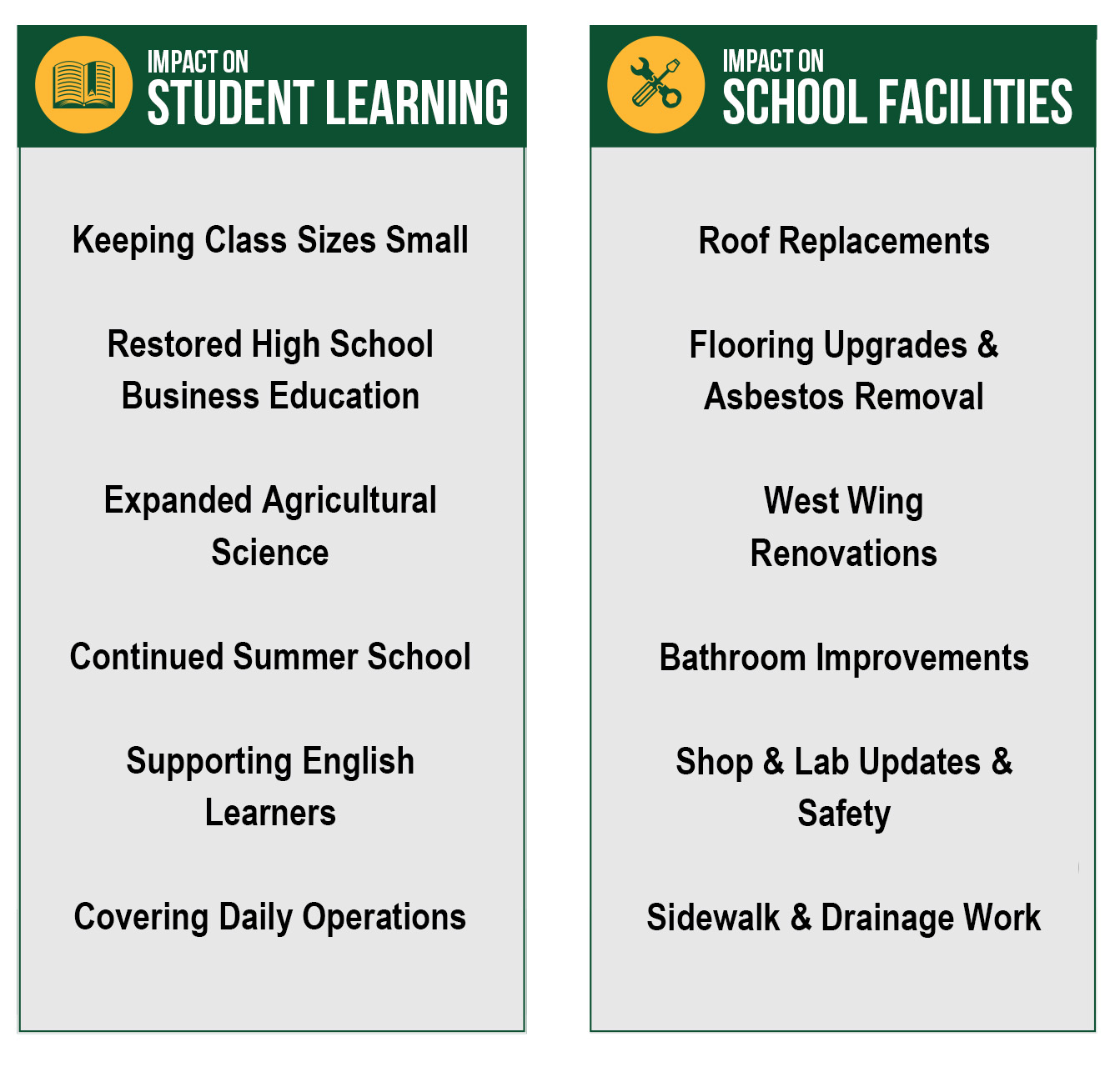
● Pay for transportation, utilities, and other ongoing operating expenses
● Maintain class sizes and student services appropriate for enrollment
● Maintain current programming levels
● Maintain current staff wage levels
● Continue basic building maintenance
● Continue current levels of support for instruction and safety
10. What will happen if the referendum fails?
Without an approved operating referendum, the district must reduce basic programming and services, possibly including (but not limited to):
● Reduce staff positions
● Reduce bus route(s)
● Reduce or eliminate middle school sports
● Defer curriculum updates
● Reduce maintenance and upkeep
● Reduce or eliminate summer school
(Reductions make attracting staff and families very difficult.)